




Suggested videos

To mark the 50th anniversary of Earth Day, Professor Gabrielle Wong-Parodi shared her reflections on April 17, 2020.
She discussed the successful implementation of resource-saving default settings on appliances, emphasizing their positive environmental impact.
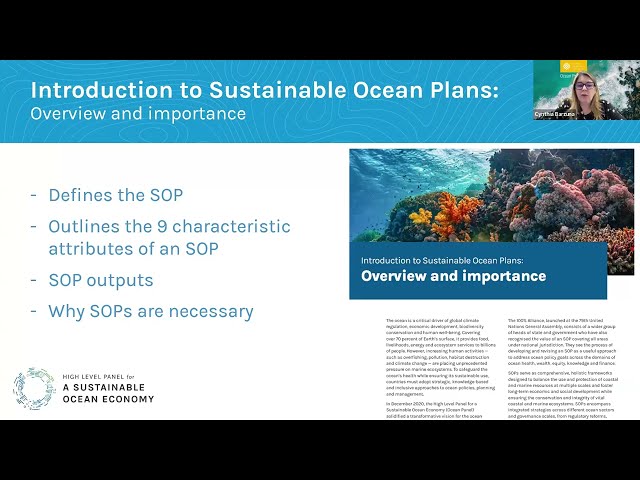
Explore practical strategies for sustainable oceans with our upcoming webinar. This session provides a comprehensive practitioners' guide to developing effective plans.
Drawing from the Handbook on Sustainable Oceans Plans, it offers vital insights for implementation.

An event titled "Women in Action for Climate Justice and a Just Transition: Path to COP30 and Beyond" brought together diverse global women leaders. They highlighted the importance of a Just Transition and presented comprehensive, intersectional strategies to advance community-led climate solutions, phase out fossil fuels, protect democracy, and strengthen the climate justice movement.
Discussions focused on critical topics such as forest protection, reforestation, gender-responsive climate policies, fossil fuel resistance, food sovereignty, Indigenous and human rights, Rights of Nature, and strategic campaigns for COP30 and future climate action.
Prominent speakers included Thilmeeza Hussain (UN), Eriel Tchekwie Deranger (2024 Climate Breakthrough Award Winner), Bridget Burns (WEDO), Tzeporah Berman (Fossil Fuel Non-Proliferation Treaty), Colette Pichon-Battle (Taproot Earth), Jozileia Kaingang (ANMIGA), Taily Terena (2025 Global Citizen Prize Winner), and Casey Camp-Horinek (Ponca Nation Environmental Ambassador). The event was moderated by Osprey Orielle Lake, Founder and Executive Director of Women’s Earth and Climate Action Network (WECAN).

A Pew Research Center survey indicates that while highly religious Americans generally express less concern about climate change, young religious adults—including evangelicals under 30—are significantly more likely to acknowledge human-caused global warming and its severity. Across U.S. college campuses, various religious groups (Christian, Jewish, Muslim) are now advocating for collective action to reduce carbon emissions.
On April 26, 2023, a panel featured young Americans from diverse religious backgrounds. They discussed how their faith informs campus activism, shared their evolving perspectives, and explored their impact – or hoped-for impact – on older generations within and beyond their traditions.

At UNFCCC COP25 on December 4, 2019, C2G and leading experts called for urgent global discussions to address governance gaps in CO2 removal.
Claire Fyson, a Research Analyst at Climate Analytics and co-author of "Governing Large-scale Carbon Dioxide Removal: Are We Ready?", highlighted specific governance challenges related to large-scale CO2 removal, using Bio-energy with carbon capture and storage (BECCS) as an example.

While the public now grasps the serious threat of global warming, a clear path forward remains elusive. Drawing from his book, *Under the Influence: Putting Peer Pressure to Work*, Robert Frank proposes that leveraging behavioral contagion can make addressing climate change less daunting than many believe.
Robert H. Frank is the Henrietta Johnson Louis Professor of Management and Professor of Economics at Cornell's Johnson Graduate School of Management. He previously wrote the "Economic View" column for *The New York Times*.
Explore more content from the UC Public Policy Channel.

Join award-winning architect and environmentalist Duncan Stewart for a talk on the challenges of greenhouse gas emissions. He will discuss their impact on Earth's climate, the future of our youth, and biodiversity, along with potential solutions.
A pioneer in sustainable architecture, renewable energy, and nearly zero-carbon buildings, Duncan is a director of the Irish Environmental Network, Dublin Civic Trust, and Green Foundation Ireland. He also produces and presents RTE 1's 'Eco Eye' and 'About the House'.
Duncan founded Eco Ed 4 All, which develops environmental education for Irish schools and CPD courses for teachers. These cover critical themes like Climate Change, Biodiversity, Circular Economy, and UN Sustainable Development Goals.

Christiana Figueres and Tom Rivett-Carnac outline two distinct futures for 2050: one if we fail to meet Paris Agreement climate targets, and another if we achieve a carbon-neutral, regenerative world. They emphasize that immediate action is crucial to address our climate emergency, presenting this as our final, defining choice.
Figueres, a Costa Rican diplomat with 35 years of experience, served as Executive Secretary of the UN Framework Convention on Climate Change from July 2010. Her extensive background highlights the urgency of this pivotal moment.
Source: The RSA, March 4, 2020.
Environmental Scientist and Advocate
What EarthSayers stands for
Discover Diverse Voices on EarthSayers
Unlike algorithm-driven platforms that push you into a content bubble, we ensure you hear a variety of perspectives from scientists, activists, Indigenous leaders, business innovators, and everyday citizens working toward sustainability.
EarthSayers CINEMA
Watch, learn and lead—sustainability starts with you.
The Thinking Game | Full documentary | Tribeca Film Festival official selection
“The Thinking Game” is the inside story of DeepMind's groundbreaking AI research, culminating in the Nobel Prize-winning AlphaFold breakthrough. Filmed over five years by the award-winning team behind "AlphaGo," this documentary explores co-founder Demis Hassabis's lifelong pursuit of artificial general intelligence and the rigorous scientific journey from mastering strategy games to solving the 50-year-old protein folding problem.
Following its world premiere at the Tribeca Festival, "The Thinking Game" is now available to watch for free. For those interested in hosting a screening for a classroom, community, or workplace, visit: rocofilms.com/films/the-thinking-game/.


